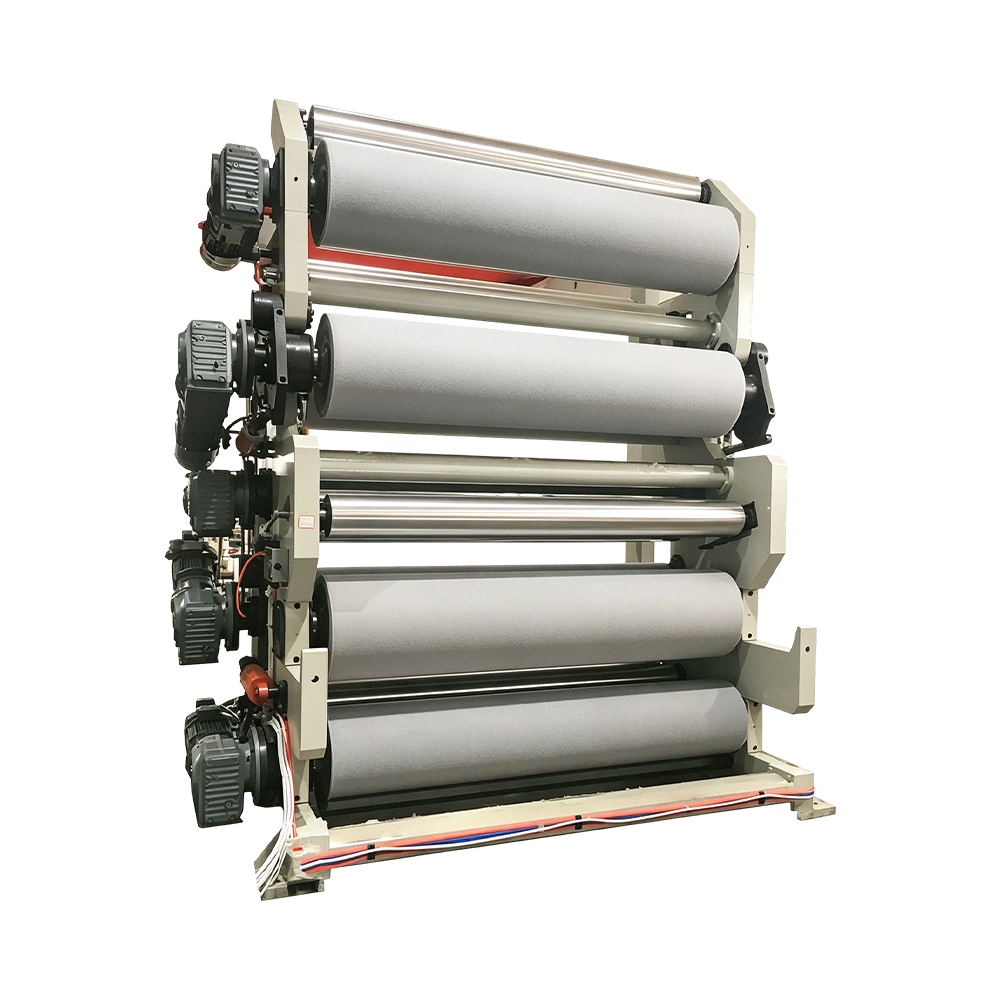
The Double‑Sided Specialty Embossing & Calendering Machine is an intelligent processing unit that integrates embossing and calendering into a single piece of equipment. It is specifically designed for simultaneous front‑and‑back pattern forming and surface leveling of webs such as nonwovens, plastic films, thin metal sheets, paper, and synthetic leathers. Featuring a synchronized upper‑and‑lower twin‑roller opposed pressing structure, the machine completes both embossing and calendering on both sides in a single pass, eliminating the traditional two‑pass flip‑over processing. The entire system is equipped with independent constant‑temperature circulation systems for the upper and lower rollers, segmented servo‑hydraulic uniform‑pressure control, and an integral cast‑steel annealed frame, ensuring consistent heating and pressure across the full width of the web on both sides—producing sheets free from curling, warping, or pattern‑depth discrepancies. This provides a highly efficient and precise double‑sided processing solution for industries including metal decoration, high‑end packaging, medical and hygiene products, and automotive interiors.
Core Process Value
·Core Process Value
Conventional single‑sided equipment requires two‑pass processing, resulting in inconsistent pattern depth and flatness between the front and back surfaces, along with positioning errors and material stretching losses during flipping. This machine uses precisely matched upper and lower specialty alloy working rollers, with pattern, roundness, and temperature settings fully locked in sync. As the web passes through the nip, both sides are simultaneously formed with raised/embossed textures, while the calendering function eliminates wrinkles and thickness variations. Two processes are combined into one, reducing both production time and rejection rates simultaneously.
·Core Working Units
Both the upper and lower working rollers are self‑produced matching composite rollers from Guangyu, manufactured from integrally forged alloy steel substrates with patterns integrally formed via five‑axis laser engraving, and surface‑reinforced with hard chromium or ceramic coatings. The upper and lower rollers are pre‑matched and run‑in prior to delivery, with pattern‑depth tolerance ≤±0.003 mm and parallelism error ≤±0.004 mm, ensuring that the patterns remain sharp even after millions of steel‑to‑steel high‑speed rolling cycles. Unlike machines assembled from purchased rollers, this equipment features roller materials, hardness, and pattern depths exclusively calibrated to the machine's maximum linear pressure, with lower refurbishment and re‑engraving maintenance costs.
Both rollers are equipped with built‑in circulating thermal‑oil temperature‑control flow channels, paired with independent temperature‑control modules, ensuring that the temperature differential between the upper and lower rollers and across the entire roller surface is synchronously locked within ≤±0.7 °C, with minimal axial temperature fluctuation. Most double‑sided machines on the market heat only one roller while the other operates at ambient temperature under pressure, causing inconsistent heat exposure on the two sides of the material—leading to curling/warping and one side with clear patterns while the other is faint. This machine's balanced heating on both sides completely eliminates such defects, resulting in a highly uniform texture across the entire roll of finished product.
·Intelligent Pressure Control System
Equipped with a segmented servo‑hydraulic uniform‑pressure control system and multi‑point pressure‑sensing feedback modules, the pressure deviation across the entire nip is ≤±0.02 MPa, capable of real‑time compensation for minor deflection/sagging of the wide roller under load—eliminating common wide‑web issues such as overly deep embossing at the edges and insufficient calendering in the center. Pressure parameters are steplessly adjustable based on the hardness of different materials—thin metal sheets, plastic films, paper, nonwovens, etc.—ensuring that lightweight substrates are not crushed while heavy sheets achieve fully compacted patterns. A single machine covers diverse material‑changeover needs with high flexibility.
·Structural Reliability
The integral cast‑steel frame undergoes extended stress‑relief annealing to completely eliminate internal casting stresses, ensuring that long‑term steel‑to‑steel high‑pressure rolling does not cause frame deformation or resonance shift. Gears and bearing transmission components are repeatedly pre‑run and calibrated prior to delivery, with triple backlash‑calibration measures ensuring 24/7 heavy‑load operation without play or vibration. The machine operates with low noise and extremely low failure rates, ideally suited for continuous high‑volume production in building materials and packaging plants.
·Operational Economy
Two processes completed in one pass reduce combined labor and energy costs by over 30 %; closed‑loop intelligent control of pressure and temperature reduces material stretching and breakage rejection rates by 80 %; factory‑matched paired rollers offer longer service life, significantly reducing annual replacement and grinding frequency. One machine accommodates multiple materials—metal, film, paper, and nonwovens—eliminating the need for multiple single‑function units and optimizing both floor space and equipment investment. Finished sheets exhibit symmetrical and well‑proportioned textures on both sides, with uniform three‑dimensional relief effects. After calendering leveling, the sheet surfaces achieve the required gloss and flatness, free from wavy warping or thickness discrepancies, significantly enhancing the market premium potential of end products.
Application Scenarios
·Metal decorative sheet processing
Galvanized steel, color‑coated steel, aluminum, and stainless steel sheets—double‑sided anti‑slip diamond/orange‑peel embossing plus sheet leveling for elevator cabs, interior wall cladding, cabinet panels, and curtain‑wall substrates.
·Plastic films and plastic sheet finishing
PET, CPP, and PLA biodegradable films—double‑sided matte texture embossing plus calendering shaping to achieve a consistent soft‑matte feel on both sides for high‑end food packaging and electronic protective films.
·Nonwoven hygiene and home textile materials
Spunlace and composite nonwovens—double‑sided flow‑guide pattern lamination plus fabric leveling to enhance fabric loft, water permeability, and breathability, suitable for maternal/child products and home‑textile wipe fabrics.
·High‑end artistic packaging and bookbinding papers
Gift box cardboards and art papers for deluxe illustrated books—double‑sided three‑dimensional relief embossing plus calendering to increase paper stiffness and elevate printing/binding quality.
·Synthetic leather automotive interior substrates
PU/PVC leather base fabrics—double‑sided texture shaping and leveling for consistent hand‑feel on both sides, providing a stable foundation for subsequent coating applications, specifically supplied to automotive interior leather processing plants.
Specifications
| Exclusive Core Parameters |
Upper/lower roller synchronized temperature differential |
≤±0.7 ℃ |
| Nip pressure deviation across full width |
≤0.02 MPa |
| Upper/lower roller parallelism error |
≤0.004 mm |
| Single-pass productivity improvement |
55% |
| Texture depth tolerance |
±0.003 mm |
| Pressure control |
Segmented servo-hydraulic closed-loop regulation |
| General Specifications |
Effective working width |
1200mm–3600mm |
| Maximum line speed |
60–160 m/min |
| Compatible material thickness |
0.1mm–3.2mm |
| Temperature control medium |
Circulating thermal oil |
| Installed power |
15kw–30kw |
| Compatible materials |
Metal sheet, plastic film, nonwoven, art cardstock |
| Certifications |
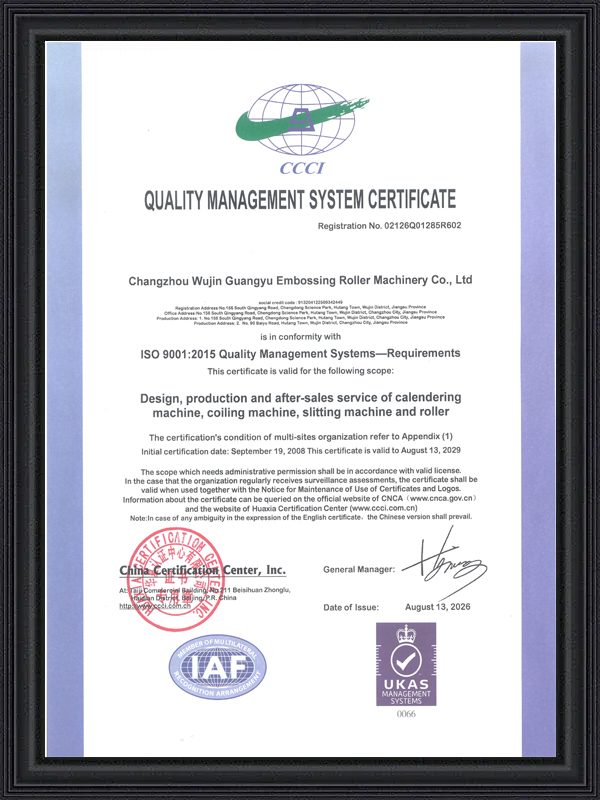
ISO9001, ISO14001, CE export certification |


 English